 Clan Coleman
Back to Australian Branches ‹--------› Forward to Mick's Family Tree
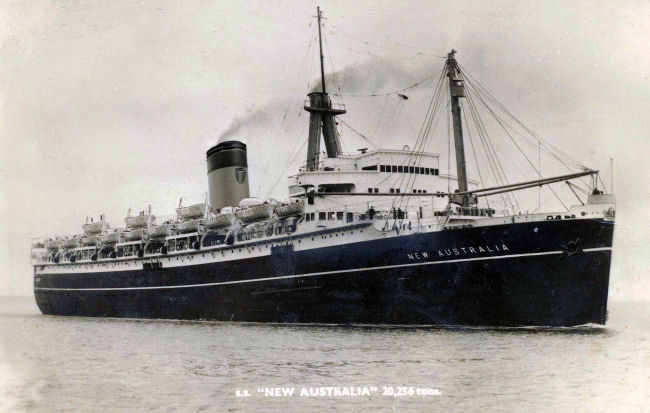
Mick Coleman is the second son and child of Pat and Norah Coleman. He was born on 22 September 1935. Mick back then was called Sonny which was a popular family name with our uncle Martin Murphy and cousin John Davoren also called Sonny. After completing his schooling at Gortjordan National School and the Christian Brothers’ College in Ballinrobe, he worked with his brother, John Joe, for the ESB (Electricity Supply Board). About one month before his nineteenth birthday, he settled in Birmingham England in 1954. After working at Cadbury’s for about nine months, he spent a few months in the construction industry before sailing for Australia aboard the ‘New Australia’ in June 55. Aboard the ship, Mick met another Irishman, John Peters, from Northern Ireland. John was an experienced diamond driller who had worked in Africa and was on his way to join Thiess Brothers in Mary Kathleen in North West Queensland at Australia’s first uranium mine. Both were among the first to come to Australia under the Assisted Migrant Scheme, the ‘10 Pound Scheme’ as it was called, that was introduced by the Australian Government. I believe Mick was meant to have stayed in Sydney although I couldn’t see the Government objecting to his opting for Mary Kathleen on the other side of the never never.
So on their second day in Sydney, they took the train for the long trip to Brisbane. On arrival, they reported to Immigration to claim back their entitlement of five pounds, 50% of the cost of the passage out, a fair sum back then, before calling at the headquarters of Thiess Brothers where they were warmly welcomed by Pat, Cecil and Les, three of the seven brothers involved in the company. They were provided with lunch and accommodation and given two days off to take in the sights of Brisbane before heading north in the company plane to Townsville where they stayed for the weekend before boarding the silver ‘Overlander’ for Cloncurry located in the Gulf Savannah region of the state.
Today, Cloncurry is still an important mining town with a population of 2,758. Back in 1861, John McKinlay, leading a search for Burke and Wills, reported traces of copper in the area. Some six years later, pastoralist Ernest Henry discovered the first copper lodes. During World War 1, Cloncurry was the centre of a copper boom and the largest source of mineral in Australia. But shortly after the war a pastoral industry took its place when copper prices slumped. Qantas was conceived there and the original hangar can still be seen at the airport. The town also became the first base for the famous Royal Flying Doctor Service in 1928 which was founded by Irishman John Flynn, and later still it became the training centre for the state’s police force.
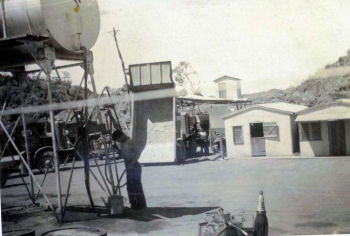
When Mick and John arrived there in 1955, its population was a mere few hundred. It boasted, however, five hotels to cater for the visiting bushmen and miners escaping the blistering sands and the scorching blinding sun pounding away hour after hour, day after day, week after week until the only relief was escape. The respite was welcome and indeed essential to one’s sanity. As severe as it was, this wasn’t the only predicament that miners like Mick and John faced. On arrival in Cloncurry, they were taken by jeep to the uranium mine at Mary Kathleen, a centre located about 65 kilometres from Cloncurry in the direction of Mount Isa and now long abandoned.
 |
|
Section of the Camp at Mary Kathleen |
The incessant heat and scourging light, the repetitive work, the dust and tormenting isolation, all took their toll in one form or another. Mick and John Peters worked as a team out in the open and up to a few miles from the mine drilling to locate the much valued uranium. Being exposed to the elements had its advantages over the conditions in the dusty mines where dry drilling was the order of the day. The union bosses who from time to time drove up in their big cars showed no concern for the health and welfare of the workers. They knew who lined their pockets and so only approached so far before getting back into their cars.
Though paid by the foot drilled, how much Mick and John actually collected at the end of the week was entirely up to them as the number of bores recorded was never checked. It meant that they were collecting on average up to ten times the weekly wage. There was no scarcity of diamond drills to replace those left behind stuck in the bores and those not stuck in the bores. The American bosses in charge were more than willing to supply all the drills requested though some of them were making their way into the hands of other mining companies.
A high percentage of those working in and around the mines and towns were in fact Irish and the scenes they regularly created when they hit town didn’t quite endear them to the local constabulary. Though company policy was a bottle of beer per person a day, alcohol was a problem as many of the men sneaked out of camp during the night and were in Cloncurry an hour later. There was no scarcity of vehicles. Mick found the aborigines who worked there to be reliable, intelligent, very friendly and hard-working. Pat Thiess was in charge of operations and come Friday it was not unusual for him to down tools for the weekend and head for town with the boys. Mick has many pleasant memories of their taking him to Mary Kathleen for his 21st Birthday. The mine had its own preferred hotel in Cloncurry, the “Serwyn” that among other things provided good entertainment and occasionally conducted talent quests.
|
When John Peters did not return, however, as planned after a weekend in Cloncurry, Pat Thiess dispatched Mick to locate his friend and bring him back. Having sought him in vain in the usual places, he turned to the publican’s wife at the “Serwyn” who was well respected by the townsfolk. The local police didn’t have the best of reputations for tolerance, and so if he was to get anywhere with them he needed the help of someone like her. His hunch was right. The police had picked up John and sent him to the Goodna Mental Asylum in Brisbane when all he really needed was time to dry out somewhere away from the alcohol. Mick was very concerned for his friend and immediately took a plane to Brisbane. He decided to first visit Immigration and to explain the story to them in the hope that they might be able to help. As it worked out, they were very helpful. Mick located John and signed him out. He was looking and feeling remarkably well but had no hope of getting out of that place on his own. |
John Peters |
|
Bill and Mick had arranged to meet at the Jubilee Café, located at Haymarket in George Street. Bill who had arrived a bit early was looking forward to a good chat with Mick about life in the outback but nothing prepared him for what walked through the door. Henry Lawson himself would have taken a step back. A tall, thin, dishevelled, bearded, bare-legged and dark-tanned specimen in tattered shorts, sandals and t-shirt had appeared out of nowhere with a bag slung over the right shoulder from which projected rather menacingly the barrel of a rifle. Mick had arrived in Sydney but not before an encounter with a courageous representative of the law at Central Railway Station while strolling along the platform rifle over the shoulder on his way to meet Bill. Mick was told that people just don’t do this in Sydney, walk through the streets sporting a rifle over their shoulder. To the relief of the plain-clothes policeman, Mick explained that he used the rifle to shoot only wild turkeys and pigs. The confrontation came to a close with the policeman reminding him that, as he was unlikely to find any in Sydney, he should take the rifle apart and place it in his bag. |
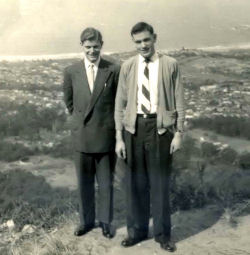
Mick(R) & Martin at Bulli Tops 1958 |
Back to Australian Branches ‹--------› Forward to Mick's Family Tree